If you live on the Gulf Coast, near Miami, or in a wind-swept section of New England, you know the terror that storm season brings. Windows rattle. Doors strain at their hinges. Every heavy wind you think, “Is my home really safe?”
That’s a pretty valid worry. Coastal towns like Boston and Miami often experience tropical storms and nor’easters with persistent winds over 60 mph, exposing every flaw in a building’s shell.
Often the most vulnerable site of those flaws is the exterior door. A door that admits air, that flexes under pressure, or that corrodes from salt-laden air is not only difficult to live with; it’s a structural liability.
So what should you look for in an external door if severe winds are a reality for you? And why are aluminum doors, and in particular thermally fractured aluminum doors, always suggested for these environments? This guide explains it.
What High-Wind Environments Actually Demand from a Door
Before we go into the materials, it’s good to understand what a door in a windy place actually endures. It’s not just the big events, the hurricane or the nor’easter. It’s the cumulative effect of years of fluctuating pressure, moisture, and temperature. A door that works well must manage all of it.
1. Sturdy Door Frame Structure
The whole mechanism is built around the door frame. If the frames are too small or made of weak materials, the first signs of danger are hardly detectable. A door that has trouble closing, minuscule gaps at the corners or a faint whistling with the increasing wind.
Those little things add up over time to seal failures, water incursion, and ultimately structural damage.
A strong frame is more than just a door holder. It spreads the wind pressure over a larger region and, therefore, reduces the stress on any one location.
Thermally broken aluminum door frame material is one that lends itself particularly well to this purpose.
The aluminum profile has a very good strength and a very good resistance to deformation. The thermal break stops the cold from passing from the metal to the inside; otherwise, there would be problems of condensation and long-term corrosion.

And if you are wondering, “Are aluminum door frames strong enough for windy places?” The response is a loud “Yes!” if the profile thickness and the quality of construction are sufficient to meet the demands of the climate.
2. Excellent Sealing Performance
Anyone who has ever braved a nasty storm with a poorly sealed door knows just how awful it is. Cold air rushes around the picture. Rain slips beneath the door. On the worst nights you can hear the chaos outside like you were standing in it.
A good seal is not a luxury, it is what makes an outside door functional and not an expensive draft excluder.
Good exterior doors have several layers of sealing: compression gaskets along the edges of the door, brush strips down the bottom, and tight-tolerance machining between the door leaf and frame that leaves no noticeable gaps. The result is a door that keeps the indoors comfortable even when the weather is extreme outside.
Also important is the energy efficiency viewpoint. Air leaks around doors make your heating and cooling system work harder; operating longer and costing you more. A well-sealed door is a good investment, especially in areas that require heavy heating.

3. Outstanding Durability
Exterior doors in tough climates get battered up. Finish degradation by UV. Wood swells and contracts with humidity. Rusts steel. Salt air is widespread at coastlines and increases the rate of corrosion for most metal surfaces that are not protected.
Under these conditions aluminum is better than most alternatives. It won’t swell, rot, or rust. Powder-coated or anodized (both standard on quality metal doors) will resist surface damage for decades.
That toughness isn’t only for show, either: A door that stands the test of time will also continue to secure your home in the future. One of the most practical benefits of aluminum is its durability, which is a huge advantage for homeowners tired of replacing or fixing exterior doors every few years.
4. Impact-Resistant Glass
In storm circumstances, the weakest part of a door is usually the glass panel. Standard glass shatters into pieces when hit with windborne debris, and even tempered glass, which is more resistant, breaks into jagged shards that can inflict harm.
That’s why towns susceptible to hurricanes, including Miami, Charleston, and Philadelphia, are adopting building rules that require impact-resistant glass.
Impact-resistant glass (also known as Laminated Glass) is manufactured using two or more layers of glass that are bonded together with an interlayer – commonly polyvinyl butyral (PVB).
If you break the outer layer, the interlayer joins the pieces so the opening is not violated. The design is such that the door remains intact even when hit directly by debris.
Impact-resistant glass is not only for storm protection; it gives a layer of security to your property. It is also a harder substance to break through than normal glass, which is also a big deterrent to break-ins.

Why Aluminum Doors Excel in High-Wind Conditions
1. High Structural Strength and Wind Pressure Resistance
One of the defining properties of aluminum is its strength to weight ratio. High strength aluminum alloy profiles can take a lot of pressure from the wind without being bent out of shape. This is important when a door is being pushed on by a constant wind for hours at a time in a storm.
Good quality aluminum doors are usually tested and rated for certain wind pressure loads, so a homeowner has a measurable standard instead of a nebulous assurance.
The structural stability is an advantage also for the sealing system. A door that bows under wind pressure, no matter how good the original seal, will, in time, develop gaps. Those joints are sealed by an aluminum door that preserves its shape, so performance is maintained storm after storm.
2. Exceptional Sealing — Inside and Out
Aluminum doors are very well sealed because of precision. The door leaf is flush with the frame. High quality profiles are machined to precise tolerances so you don’t need to rely on compression to fill gaps .
Additionally, multiple layers of rubber sealing strips are utilized for enhanced protection, and the bottom threshold, a usual entry point for air and water, is often safeguarded by a heavy-duty weather bar or an integrated drainage system that directs water away instead of allowing it to accumulate.
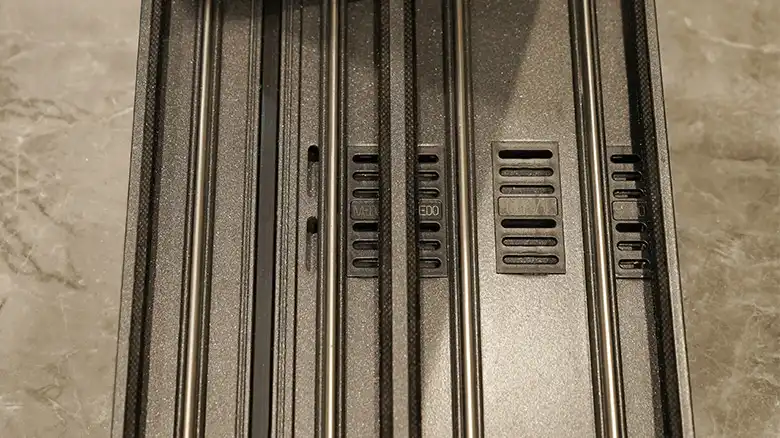
If you’ve ever tried to see if your present door is sealed well – putting a piece of paper at the edge, feeling with your palm for drafts – and found lots of leakage, a well-designed aluminum door is one of the easiest answers you can get.
3. Corrosion Resistance for Coastal and Humid Climates
The salt air will eat away at many conventional door materials. Steel doors can rust if not properly maintained. Wood soaks up moisture, expands, and eventually curves. Aluminum, however, naturally develops a protective oxide covering that prevents additional corrosion — and when finished with powder coating or anodizing, it is very well adapted to coastal conditions.
This is important in practice because a rusted or warped door is not simply unattractive; it is compromised. The frame may not be right any more. The seals may not even be in touch anymore. If you’re a homeowner in regions like coastal Florida or the Pacific Northwest, corrosion resistance is not a “nice to have” feature, it’s a “make or break” characteristic.
Recommended Aluminum Door Types for Windy Environments
1. Aluminum Hinged Doors
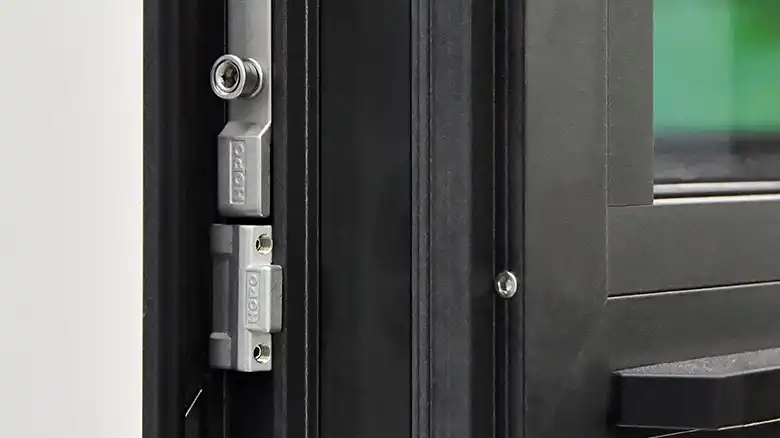
In windy places, hinged doors have a natural benefit. When closed, they lock at multiple locations to the frame to make a complete seal around the perimeter. No track exists for the debris to jam in, and the construction is essentially rigid.
SUMMIT thermally fractured aluminum hinged doors are Energy Star, NFRC, and CSA certified – third-party verification that these doors fulfill stringent performance standards.
They can also be bought with multi-point locking systems which apply closure force across the entire height of the door not just at a single latch point. That’s important for an exterior door in a storm-prone area.
2. Reinforced Aluminum Sliding Doors
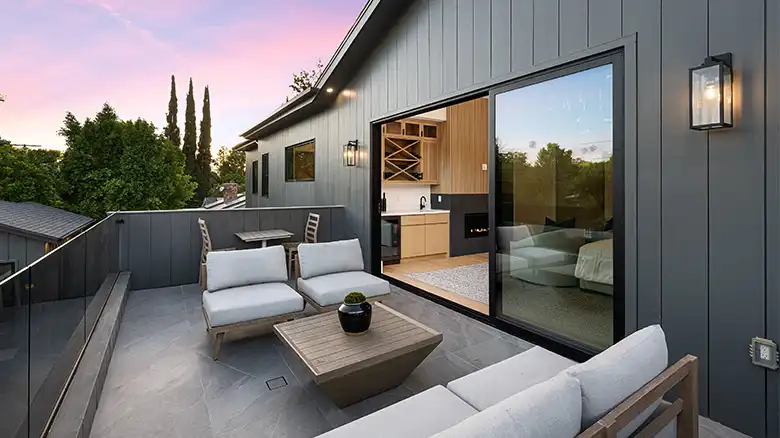
Sliding doors are a favorite choice for terraces and balconies, and it’s easy to see why – huge glass panels, little space needs, and a visual link between inner and outdoor environments.
In windy locations, however, the weight of the wind can be a disadvantage for regular sliding doors: the panels flex, debris can collect in the tracks, and the sealing performance is more difficult to maintain than with hinging designs.
And reinforced aluminum sliding doors tackle these issues immediately. Thicker aluminum profiles for more stiffness. Heavy-duty roller systems ensure smooth performance under stress.
SUMMIT’s thermally fractured aluminum sliding doors have multiple heavy sealing strips to help improve airtightness and multi-channel drainage holes that actively handle water infiltration and not only rely on seals. They are Energy Star and NFRC certified, too.
3. Aluminum Folding Doors with Heavy-Duty Tracks
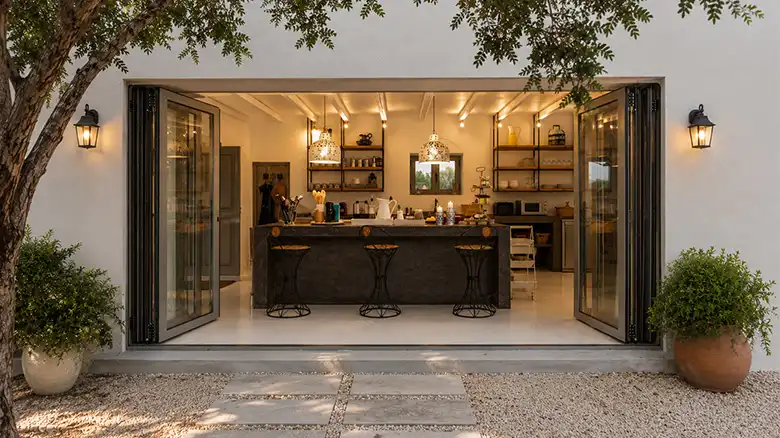
Folding doors offer something no other form of door can, the capacity to fully open a wall between indoor and external environments. That’s an attractive characteristic, but it poses engineering issues – especially in windy locations where huge, lightweight panels might behave unpredictably under stress.
Heavy-duty track systems with reinforced aluminum alloy frames, high-strength rollers, and solid guide rail designs overcome this problem by supporting the combined weight of several door panels without flexing.
SUMMIT heavy-duty track aluminum folding doors go one step further with thermally broken construction, multi-point locking systems for security, and Energy Star and NFRC certification for proven energy performance.
FAQs
Thermally fractured aluminum doors – hinged, sliding, and folding – are among of the strongest options on the market. They combine structural strength, multi-layer sealing, and corrosion resistance in a package that operates well over the long haul.
Wind ratings differ by area and municipal construction codes. In hurricane areas, seek doors tested and certified to applicable ASTM or Miami-Dade requirements. NFRC-certified products, including SUMMIT’s door line, come with independently confirmed performance statistics.
Look for signs of a poor seal:
- Light around the door frame
- Winds at the bottom or corners
- Wetness on the interior surfaces
- Wind noise during storms
If you see any of these, it’s likely worth examining if the door’s sealing system is intact.
The Bottom Line
Choosing an outside door for a windy area is not just a matter of taste, though. It’s a utilitarian consideration with actual implications for comfort, energy costs, and safety. The main aspects are strength of structure, wind pressure resistance, sealing performance, and material durability.
Aluminum checks all the boxes, and thermally broken aluminum doors lift the bar even further with the added benefits of energy efficiency and independently confirmed performance.
Designed expressly to satisfy the demands of tough climates, SUMMIT’s line of thermally broken aluminum doors – hinged, sliding, and folding – is ideal.
If you are replacing an external door or building in a wind-prone location, it is worth checking out what SUMMIT has to offer. Their staff can assist you in choosing the perfect door for your location, your architecture, and your performance requirements – and provide you a quote when you are ready.